Decoupling Capacitors

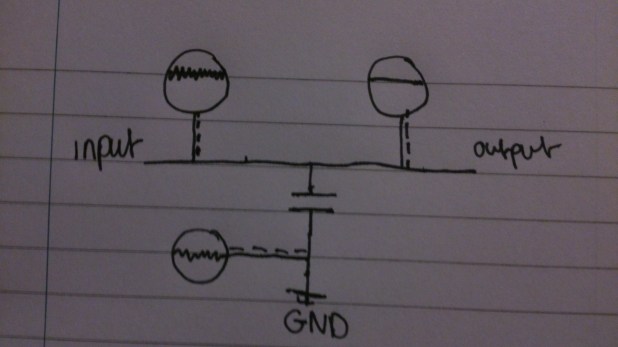
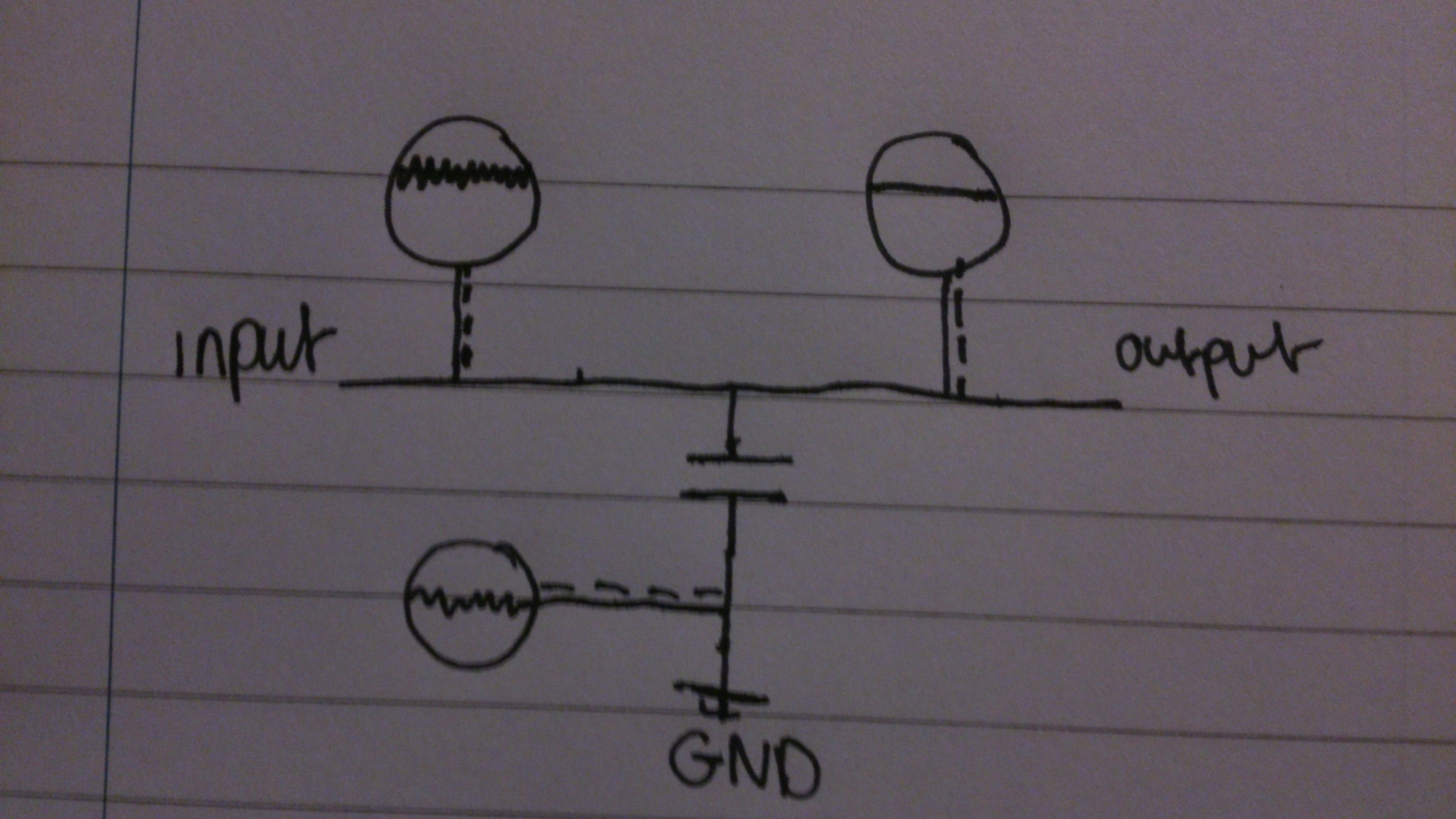
Capacitors block DC whilst allowing AC through. If there is noise present on a DC voltage, a capacitor can link the circuit directly to ground. The effect of this is that any noise (as AC) will filter down through the capacitor to ground, whilst DC will pass though the rest of the circuit as though the capacitor wasn’t there. When used in this way it is known as a decoupling capacitor.

coupling capacitor

Operational Amplifiers

Op Amps (Operational Amplifiers) are composed of two inputs, an output, and positive and negative power supply pins.

Op Amps can be used in many different set-ups, among them being: Voltage Comparators, Inverting and Non-inverting amplifiers, Summing amplifiers, and Difference amplifiers.

In Op Amps, the voltage of the output is dependent on the voltages of the two inputs. If the Inverting input is higher, the output will be the same as the negative supply. If the Non-Inverting input is higher, the output will be the same as the positive supply.

Pins 2, 3, 4, 6, and 7 are the only pins which need to be connected to the circuit in order to use the Op Amp.

LM741 Operational Amplifier actual viewop amp schematic

The Basics – Volts and Amps

All circuits require an electric current to work, this is the flow of electrically charged particles. The rate at which current flows through a circuit is measured in amps.

In order for current to flow, there needs to be a potential difference between two points. This is measured in volts. If the positive terminal of a battery is 5v and the negative terminal is 0v, the potential difference is 5v. As long as the potential difference is above 0, current will flow.

basics

Diodes

Overview

A diode is a semiconductor which has two terminals: an anode and a cathode. They are composed of two layers of semiconducting material, one side doped to make it an N-type semiconductor, and the other doped to make it a P-type semiconductor. The anode is on the side of the P-type, and the cathode is on the side of the N-type.(More information about types of semiconductors can be found here: ‘https://tphelectronics.com/2016/09/30/semiconductors/‘).

One of the main characteristics of diodes is that they only allow current to flow in one direction. This means that they can be used to filter out alternating current, or even rectify it with the use of a diode bridge.


Configurations

They’re used both in forward bias, and reverse bias. This refers to the direction in which current flows (forward being anode to cathode, and reverse being cathode to anode).

When forward biased no current flows through the diode until more than the minimum voltage is applied (This is because of the depletion region). This means that it can be used to filter out voltages below this value (e.g noise). The value itself is dependent on the type of diode.

When reverse biased only a few nanoamps flow through the diode.However, If the voltage applied is too large, it’ll cause the diode to breakdown. In most cases this will destroy the diode, but the breakdown in zener diodes do not destroy it (this is used to regulate voltage).

diode-diagram-label